
Most couples start with the venue, then the date, and only later realize that someone has to stand in front of everyone and actually marry them. That person shapes the ceremony more than almost any other decision. They set the tone, the pacing, and how much of your story ends up in the room.
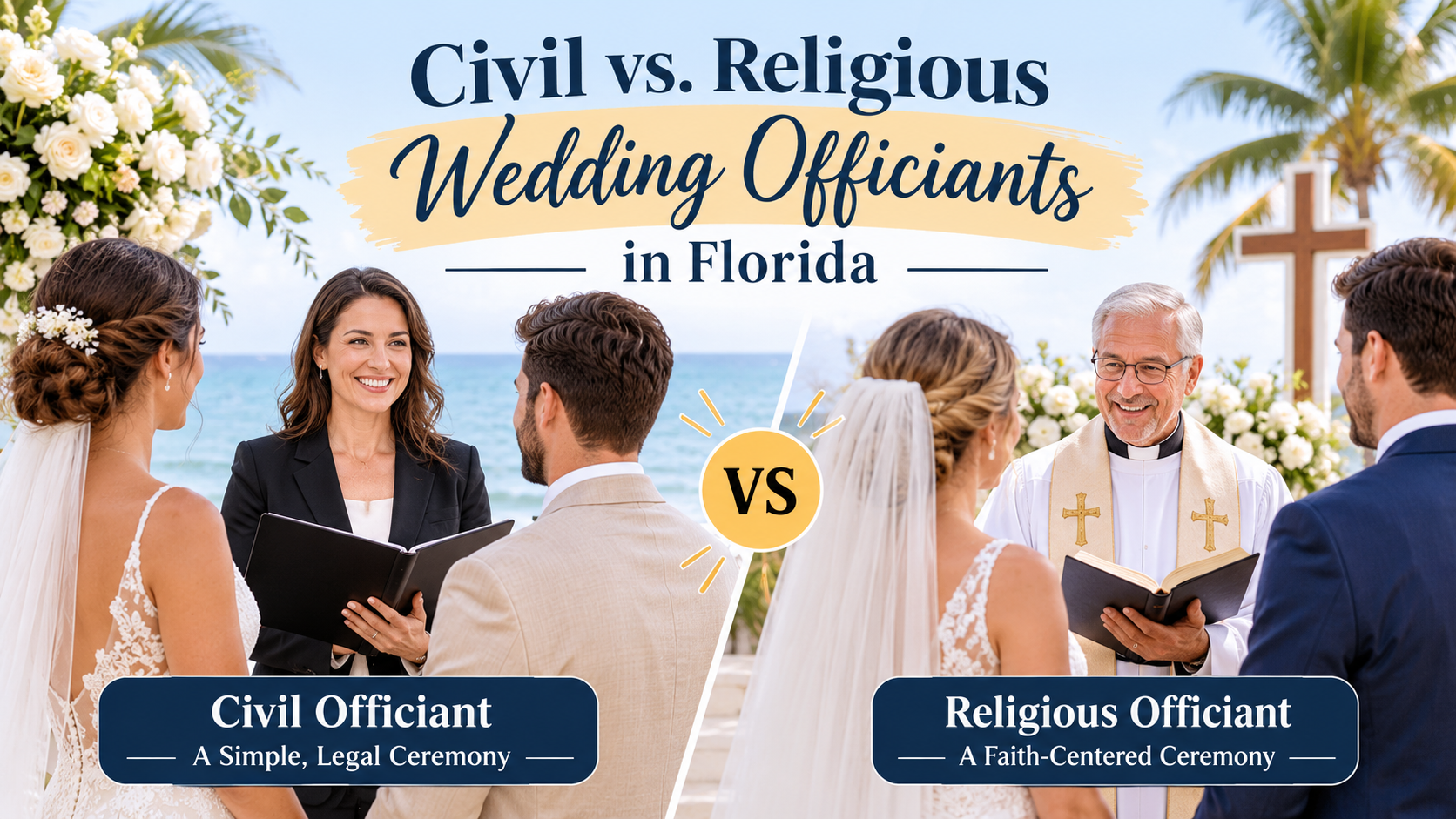
In Florida, the choice usually comes down to two paths: a civil officiant or a religious one. The difference is less about “religious vs. not” than people assume, and it affects where you can marry, how much the ceremony can be customized, and who you’ll be working with. If you’re comparing wedding officiants in Florida, here’s how to think it through.
First, what Florida requires
Whichever path you choose, the legal skeleton is the same. You need a marriage license from a county clerk’s office, and that license is good in any Florida county. Someone authorized under state law has to solemnize the marriage, and the signed license must be returned to the clerk afterward so the marriage is recorded.
Florida is flexible about who counts as an authorized person. The list includes ordained clergy, judges, clerks of the circuit court, and notaries public, among others. That last one surprises many couples. A Florida notary can legally marry you, which is a big reason civil ceremonies here are so accessible.
Fees, waiting periods, and license validity can change. Florida residents may face a waiting period unless they complete an approved premarital course, while non-residents generally don’t. Confirm current rules with the clerk’s office in the county where you’ll apply.
What “civil officiant” actually means
A civil officiant performs your ceremony in a non-religious capacity. That could be a judge, a clerk, a notary, or a professional celebrant with the authority to solemnize marriages. Their job is to make the marriage legal and to make the moment feel like something.
The format is usually light on ritual: a welcome, a few words about marriage and about you, vows, a ring exchange, and the declaration. No scripture, no required prayers, and no one asking about your faith.
Civil ceremonies suit couples who:
- Come from different religious backgrounds, or none
- Want a short ceremony without feeling like they’re skipping something
- Are marrying on a beach, in a backyard, or at a courthouse, where a formal house of worship doesn’t fit
- Want full control over the language, including humor, poems, and personal stories
“Civil” doesn’t mean “cold.” A good celebrant can write a ceremony that’s warm, funny, and specific to you. The quality comes from the person, not the category.
What a religious officiant brings
A religious officiant is a pastor, priest, rabbi, imam, or other ordained leader who marries you within a tradition. The ceremony carries the structure, language, and symbolism of that faith: blessings, readings, rituals, and sometimes a set sequence of steps.
This path makes sense when the faith itself is part of why you’re marrying. For many couples, it matters that the ceremony connects them to parents, grandparents, and a community that has marked these moments the same way for generations.
Some practical points to expect:
- Preparation. Many clergy ask couples to complete premarital counseling or attend a few sessions beforehand.
- Membership or affiliation. Some congregations marry only members, or couples who meet certain criteria. Others are more open.
- Venue expectations. Some clergy prefer or require the ceremony to take place in the sanctuary. Others will travel.
- Less script freedom. You can usually personalize vows and readings, but the core structure often stays fixed.
The gray area: online-ordained officiants
Plenty of Florida couples ask a friend or relative to officiate after getting ordained online. It’s a popular route and it works for many weddings, but it sits between the two categories and has its own considerations.
Online ordination can make a ceremony deeply personal, since the person speaking knows you both. The tradeoff is experience. Marrying people is a skill: projecting over wind, keeping the ceremony moving, handling a dropped ring, and getting the paperwork right. A nervous friend who forgets to return the license, or signs it incorrectly, can create a headache you won’t discover until later.
If you go this route, rehearse. Make sure your friend reads the clerk’s instructions on filling out and returning the license, and consider whether a professional should stand beside them as backup.
How to decide: questions worth asking each other
Instead of weighing categories, try answering these as a couple:
- What do you want people to feel in the first two minutes? Reverent, playful, intimate, grand? Your answer often points toward one style.
- Whose expectations are in the room? If one family would be hurt by a secular ceremony, or another would be uncomfortable with a religious one, decide how much that matters to you.
- How important is a ritual you didn’t invent? Some people find meaning in words that have been said for centuries. Others want every sentence to be theirs.
- Where are you marrying? A courthouse, a sandbar, a church, and a resort lawn each lean toward different officiants.
- How much time do you want to invest beforehand? Counseling requirements add weeks. A celebrant meeting might take one or two conversations.
If you disagree, that’s useful information, not a problem. A blended approach is common: a civil celebrant who includes a reading from a faith tradition, or a clergy member who allows personal vows.
Where wedding packages fit into the decision
If you’re browsing wedding packages in Florida, you’ll notice that many bundle an officiant with other services like a ceremony setup, photography, flowers, or a reception. That can simplify planning, but it also means the officiant decision is sometimes made for you, so read the details before you sign.
Things worth checking in any package:
- Who the officiant is. Is the package built around a civil celebrant, or can you request clergy from a particular faith?
- How much customization is included. Some packages use a standard script. Others let you write or edit the ceremony.
- What the fee covers. Travel, a rehearsal, and a written ceremony may or may not be included. The marriage license itself is normally paid for separately at the clerk’s office, so confirm that rather than assuming.
- What happens if plans change. Ask about rescheduling for weather and about backup officiants.
A package can be a good fit if you want fewer moving parts. If a religious ceremony matters to you, though, it’s often smarter to secure your clergy first and build the rest around them.
Marrying in the Keys: what a Key West wedding officiant changes
Island weddings have their own rhythm. If you’re searching for a Key West wedding officiant, you’re likely planning something small and outdoors: a beach, a garden, a rooftop, a boat. Civil celebrants tend to dominate this style of wedding because they’re used to working around sunsets, wind, and tight timing, and they don’t need a sanctuary.
A few things to keep in mind for a Key West ceremony:
- Local experience helps. Someone who regularly marries couples in the Keys will know which spots are practical, how to project over ocean breeze, and how to adjust when weather shifts.
- Plan your license early. You’ll apply through a county clerk’s office, and the license is valid statewide. Ask your officiant how they handle filing, since many couples leave town right after the wedding.
- Religious ceremonies are still possible. They’re just less common, and usually mean bringing in clergy who are willing to travel or who are based nearby. Raise this early, since availability can be limited.
What to ask before you book anyone
Whichever kind of officiant you’re considering, a short conversation tells you a lot. Ask:
- Are you legally authorized to solemnize marriages in Florida, and how will you handle the license?
- How much of the ceremony can we shape ourselves?
- Do you meet with couples beforehand, and what does that involve?
- What’s included in your fee, and does it cover travel, a rehearsal, or a written script?
- Have you worked at venues like ours?
- What happens if you’re sick or unavailable on the day?
Pay attention to how they answer, not just what they say. You’ll spend a surprising amount of your wedding listening to this person’s voice, so it should be one you’re comfortable with.
A quick scenario comparison
A destination couple marrying on the Gulf Coast with 20 guests and no ties to a congregation will usually find a civil celebrant easier. There’s no counseling requirement, scheduling is flexible, and the ceremony can be built around the setting.
A couple raised in the same faith, marrying near family in Orlando or Jacksonville, may find a religious officiant more meaningful. The ceremony ties into their families’ history, and the preparation process is often part of the experience rather than a hurdle.
A couple with different backgrounds often does best with a celebrant willing to weave in elements from both sides, or with clergy who have experience with interfaith weddings.
Don’t forget the paperwork
No matter who officiates, the marriage isn’t complete until the signed license is returned to the clerk. Confirm who is responsible for submitting it, and by when. Ask the officiant to double-check names, dates, and signatures before leaving. Tidy filing now saves you from correcting records later, which matters when you need a marriage certificate for name changes, insurance, or immigration paperwork.
Frequently asked questions
Can a notary really marry us in Florida?
Yes. Florida authorizes notaries public to solemnize marriages, which is why many couples use them for simple ceremonies.
Do we need a religious officiant to have a ceremony in a church?
Not necessarily. That depends on the church’s own policies. Some allow outside officiants, while others require their own clergy to lead.
Is a civil ceremony less “real” than a religious one?
Legally, no. Both produce the same valid marriage. The difference is in the ceremony’s character, not its legal standing.
Do wedding packages include the officiant?
Many do, but not all. Check whether the officiant is named, whether travel is covered, and whether the license fee is separate.
Can we have both types of officiants?
It’s possible. Some couples do a legal civil ceremony privately and a religious blessing later. Ask in advance so nothing overlaps on the license.
How far ahead should we book?
Popular dates and seasons fill quickly, especially in peak wedding months and in destinations like Key West. Contact officiants as soon as your date and location are settled, and give clergy extra time if counseling is required.
What if our officiant cancels last minute?
Ask each officiant about their backup plan when you book. A second person who is legally authorized and available is a simple safeguard.
The takeaway
There isn’t a right answer between civil and religious, only a better fit for your marriage and your guests. Start with what the ceremony should mean to the two of you, check the practical details with your county clerk, and then find someone whose voice you trust. That’s usually the person who makes it feel like yours.
Planning something on the islands? Our guide to Choosing a Florida Keys Wedding Officiant goes deeper on what to look for when your ceremony is south of the mainland.